This is the first in a series of articles providing New Santa Fe Regional Trail enthusiasts new insight and perspectives into the rich history of communities and people who lived nearby this trail that so many of us run, hike, bike and horseback on. This article introduces historical tidbits of the life and times along the Pikes Peak Greenway Trail’s Pine Creek Reach that starts at the Woodmen/Rockrimmon trailhead and proceeds north about 2 miles to the Ice Lake trailhead at the southern boundary of the AF Academy. Here the Pikes Peak Greenway connects into the New Santa Fe Regional Trail.
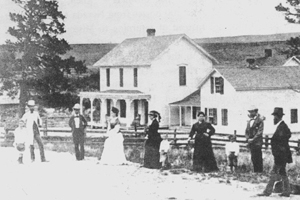
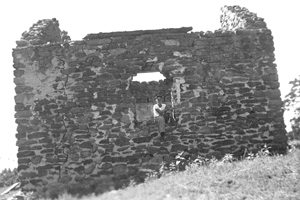
About 3/4 of a mile into our northbound run you’ll notice an open meadow to the east. It’s just before you get to a home and stable that is adjacent to the trail. There you’ll see stone foundation remnants of the Teachout homestead. In 1868, Harlow Teachout, and his widowed mother Leafy, homesteaded this area. He built a beautiful two-story hotel with a spacious dining room and eight bedrooms upstairs as well as a large stone barn and ice house attached to the hotel. This home was called the Teachout Inn.
Prior to General William Palmer’s efforts to build the Denver & Rio Grande railroad through here in 1871, the Colorado City (Old Colorado City today) to Denver stagecoach road came through here. In 1864 the stagecoach would complete one mail run per week to Denver and back. By 1870 the stagecoach made this day and a half journey to Denver three times a week. An average of 5 passengers would “enjoy” the trip. The Teachout place was the first stop for northbound stages to change out horses. The stagecoach road proceeded northeast and crossed Monument Creek over a wooden bridge. The Monument Creek often flooded and the bridge was rebuilt often.
During these pioneer times, the Indians had mixed reactions in welcoming the settlers. The local Utes were friendly and made rare jaunts amongst the settlers to sell beads and sometimes manage a free meal of biscuits. However, it was quite a different story with some Arapahoe and Cheyenne. Life in the vicinity of these marauders was fraught with danger that quickly prompted the settlers to band together to ride out hostile Indian presence. The settler’s homesteads often took on the appearance of forts with thick cottonwood or pine walls or some as thick as 3 feet and comprised of rock. The thick walls offered protection and in the case of an ice house, the walls provided insulation for keeping ice from melting (no refrigerators in those times!). Some structures had long, narrow slots serving as windows and were just big enough in some cases to stick a rifle through! During one uprising in August of 1868, settlers banded together at the Teachout Ranch and also in Monument at the McShane Ranch. Forty-two people huddled together for two weeks waiting out the would-be marauders.
In the late 1869-1870 timeframe General William Jackson Palmer surveyed this area including this specific segment of trail for the railroad he planned to build. Today you can see, hear, and feel the rumblings of freight and coal trains as they travel the route he selected. Palmer and his survey team stayed at the Teachout Inn/Edgerton House in July 1870. The Denver and Rio Grande Railroad was completed in the summer of 1871. Though there was no station at the Teachout place, passengers could flag down the train here and board. The railroaders called it Edgerton, but in reality, it was the Teachout’s place they would stop for passengers. The coming of the railroad essentially spelled doom for the Teachout’s hotel business since trains would replace the stagecoach as means of travel. However, the Teachout’s were original Colorado tourism entrepreneurs. The beautiful area around the Teachout place became a popular health resort for those battling lung problems. As many as 200 tents would be set up gathered around the house in the summer months with folks seeking to get well in the great Colorado outdoors and air. An advertisement for this Teachout recreational opportunity in the Gazette newspaper in 1874 cited “Fine riding horses, plenty of sweet cream and milk, board $7.00 a week.”
As you arrive at Ice Lake Trailhead you leave behind the courageous pioneer spirit of the Teachout family and the ingenuity of General Palmer. I wish to thank Alice Tudor for contributing to this article with her knowledge and insight of the Teachout’s and the early history of this area. Alice is a long time Colorado Springs resident whose home overlooks the Teachout homestead area. In 1970, Jack and Betsy Kitch, then living in Rockrimmon, wrote a book entitled “Woodmen Valley: Stage Stop to Suburb”. It is a great read and tells the early history of the Woodmen Valley and includes wonderful drawings of the area’s scenery. Next time, we’ll learn about the community of Edgerton (no, not the whistle stop described earlier, but a community that had as many as 350 citizens in 1902), the Edgerton Grammar School (District 20’s first school!), and also perhaps put some speed work in your run as I share an unsolved mystery of this area. (January 2005)